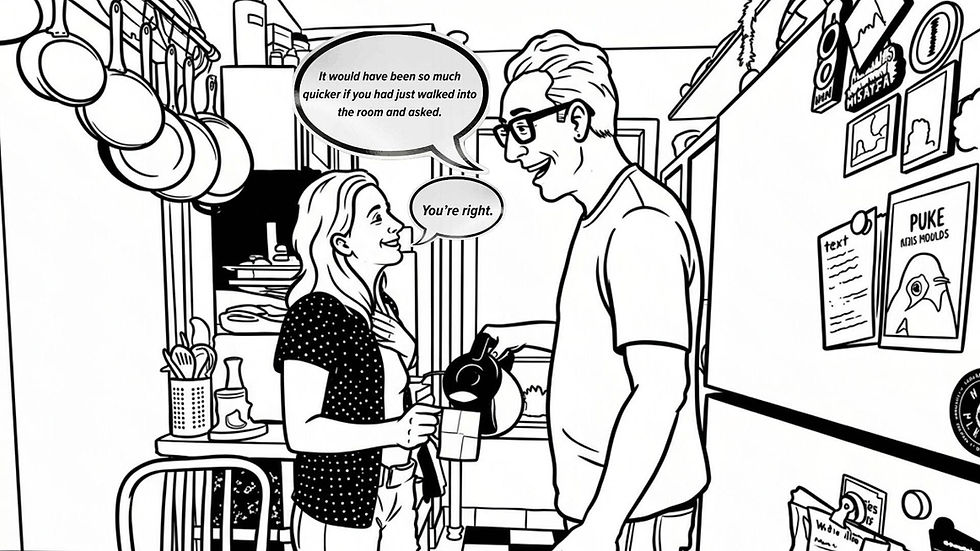
The story we tell ourselves

A little over a month ago, I was on my way to deliver a closing keynote for a room full of brilliant humans for an AWS Community Day in Budapest, Hungary. The trip fell on my husband's birthday.

I wanted him to feel loved on his big day, so I bought a gift card from a restaurant we've been going to for years in our neighborhood. My teenage daughter would take him.
I had a lovely exchange with the host.
"My daughter will be using this to take her dad out for his birthday," I said.
"Great!" she said, "We will make sure to take care of him! I will note it on the reservation."
I really didn't think I needed to say anything else. Why would I?
We live less than a block from this restaurant and have celebrated anniversaries there. We've met friends for happy hour and have taken out-of-town guests. My husband and I sit at the bar sometimes with a glass of wine and a steak. I would definitely consider ourselves regulars.
All I did was buy a gift card. Easy peasy, right?
My daughter is 15 and black. We adopted her when she was a newborn. My husband is white. I didn't think I needed to say that to the host, either, because it never occurred to me it was information anyone needed.
The night my daughter dressed up and took my husband to dinner, the police showed up at their table. They told my husband and daughter that a fight, a disturbance, was reported. There was no fight. No disturbance. There was just a father and daughter celebrating a birthday.
I wasn't there. I was on a stage in another country, talking about communication, while somewhere in my own neighborhood, a story got told about my family that has absolutely nothing to do with who we actually are.
Here is what I believe happened.
I still don't know who called, or exactly what they said. I have requested these records. I do, however, have my suspicions it was a staff member at the restaurant. My husband said he didn't recognize any of the staff we normally see and anyone else from the street or another guest in the restaurant didn't make sense.
What I do know is this: a black teenager and a white man, sitting together, having dinner, did not match a picture in someones' head.
That is the part that keeps swimming in my brain, because it's not what most people mean when they say bias.
What got noticed wasn't my daughter. It was the two of them together. A pairing that didn't match what a family is supposed to look like.
What bothers me the most is that this person never checked their assumption. And because of this, they actually caused harm where they probably thought they were doing something helpful.
Here is the one step that could have prevented all of this.
Nobody at that restaurant, or wherever the call came from, paused to ask a single question before acting on the story in their head.
Not, "are you two together?"
Not, "what are you celebrating tonight?"
Not, "what brings you in this evening?"
Any of those would have answered the actual question swimming in their head within thirty seconds, in a way that let my husband and daughter answer for themselves instead of being decided about! Whoever this person was, skipped the question and went directly to the conclusion and that conclusion brought the police to the table for everyone in the packed restaurant to witness. My husband described it as a record scratch moment. It was all eyes on them.
This was a communication failure before it was anything else. Bias is what shapes the story we tell ourselves about what we're seeing. The story stays private and is mostly harmless right up until we act on it without checking. The check is what a lot of us skip, because asking might feel slower or more awkward than assuming, and because our assumption usually feels like facts when we're inside of it.
Here is why this matters beyond the restaurant and why I appreciate you giving me space to share this vulnerable story with you.
I think about this constantly in my work and in a smaller lower-stakes way. Maybe it's a leader who walks into a room and reads the mood as "off" because of the two faces they glanced at in the front row, and then builds an entire narrative before anyone has opened their mouth. Or maybe a team who is silent means agreement, or means disengagement, and was never asked which. We are constantly filling in the gaps with stories, and most of the time we never take the time to find out if the story was true, because nothing is forcing us to check.
And the cost of skipping that check is a misread meeting or an assumption that quietly shapes the decision. For my family, the cost was two police officers standing over my husband and daughter celebrating a birthday. Standing over two people who love each other very much but didn't match a stranger's idea of what love and family is supposed to look like.
I don't have a clean ending for this story yet, but my hope is that this this story will help at least one of my readers pause before making an assumption. To pause and ask the question before skipping to the conclusion. If something doesn't seem to match what you expect, that is just information about your expectation, not about the person in front of you.